
The International Day of ‘Argania’, celebrated every May 10 since the United Nations General Assembly proclaimed it in March 2021, is more than a ceremonial nod to a single species. It is a policy signal recognizing the argan tree (Argania spinosa), native to southwestern Morocco and protected within the UNESCO-designated Argan Biosphere Reserve, as a species central to biodiversity conservation, climate adaptation, food security, and women’s economic empowerment. In a world searching for models that connect ecological restoration to human development, the Argan Bio Reserve offers a living laboratory.
For the global policy community, the argan ecosystem illustrates a principle that is easy to state but difficult to operationalize: environmental sustainability and socioeconomic progress are not competing objectives but mutually reinforcing ones. This year’s observance arrives at a moment when that principle faces intensifying tests, from accelerating desertification to the structural inequities embedded in global value chains. To understand why the world pauses for a tree, one must look at what that tree holds together.
The Arganeraie on the Front Line
The “Arganeraie” covers over one million hectares of southwestern Morocco. It is a semi-arid landscape where the argan tree is the dominant tree and the ecological keystone. Rooted in shallow, rocky soils where few other trees survive, the argan forest serves as an ecological corridor against desertification. Its deep root systems stabilize soils; its canopy moderates microclimates; its leaf litter sustains a complex web of understory plants, pollinators, and soil organisms. The tree does not need irrigation or fertilizers.
Yet this ecological infrastructure is under stress. A comprehensive review published in February 2026 in Agroforestry Systems by Chebli and colleagues documents a troubling trajectory. Evidence consistently indicates declining natural regeneration and reduced stand density, driven by land-use change, high grazing pressure, and recurrent drought.
Climate projections suggest substantial contraction of suitable habitat, with direct consequences for household income, tree yield, and forage supply. The Argan Bio Reserve is not simply losing trees; it is losing the conditions under which those trees can reproduce and persist. The implications extend well beyond Morocco’s borders. If the argan forest retreats, the desertification front advances, displacing pastoral communities, degrading downstream water resources, and releasing stored carbon.
Today, in Essaouira, the 8th International Congress on the Argan Tree concludes three days of high-profile scientific exchange. Find more information here: https://www.congresarganier.com/?lang=en
From Living Labs to Landscape Resilience
Confronting this challenge requires moving from observation to intervention, and from top-down prescriptions to participatory innovation. The SALAM-MED project, funded by the European Union through the PRIMA Foundation, has done precisely that by establishing a Living Lab in the Argan Biosphere Reserve, situated in the Essaouira region. The Food and Agriculture Organization of the United Nations (FAO) serves as a dissemination partner, assisting in scaling out the tested practices aimed at restoring degraded land and enhancing socio-ecosystem resilience across Mediterranean drylands.
At the heart of the Moroccan Living Lab is a model of participatory co-creation. Rather than importing external solutions, the project brings together farmers, researchers, women’s cooperatives, non-governmental organizations, and local authorities to test, adapt, and refine innovations in the landscapes where they will be applied. Among the most promising technologies piloted is Subsurface Water Retention Technology (SWRT), impermeable basin-shaped membranes installed beneath the soil surface that capture and retain rainwater in the root zone, dramatically improving moisture availability in arid conditions.
Early results from the Living Lab have shown improved soil moisture retention and enhanced argan tree growth, offering a practical pathway for reforestation in water-scarce environments.
The scientific agenda extends further. The Chebli et al. review identifies critical research priorities: identifying climate-tolerant germplasm that can withstand projected warming; testing regeneration protocols under drought stress; refining adaptive grazing management to balance pastoral livelihoods with forest recovery; and conducting bioclimatic assessments that point to emerging suitable niches for argan cultivation in the broader western Mediterranean, a prospect that could extend the species’ conservation footprint beyond Morocco in the coming decades.
The Women Behind Argan Oil’s Value Chain
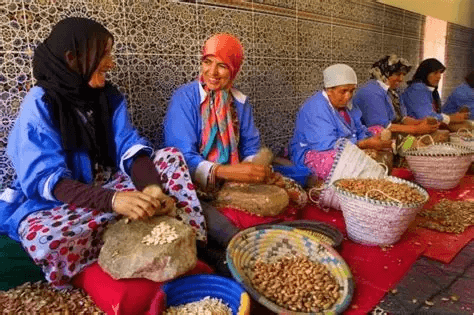
No discussion of the argan ecosystem is complete without centering the women whose labor sustains it. Women-led cooperatives have been the backbone of argan oil production for generations, applying indigenous knowledge to the labor-intensive process of depulping, cracking, roasting, grinding, and pressing argan nuts into oil.
The research is unambiguous on two counts: the methods most ecologically sustainable are also the most exploitative of women’s time, and profits concentrate overwhelmingly at the top of the value chain. A 2025 life cycle assessment by Gebrai and colleagues found that women in cooperatives and home production earn below Morocco’s legal daily minimum wage. A 2020 study in World Development Perspectives documents that as global demand for argan oil has expanded, multinational firms have captured an increasing share while small cooperatives have been pushed to the margins.
For culinary argan oil specifically, this labor carries an additional dimension. The culinary version requires roasted kernels, food-safe handling, and a flavor profile that is inseparable from traditional Moroccan production methods. It is not interchangeable with cosmetic argan oil, and its quality depends entirely on the skilled manual process that the data show is also the least compensated.
Addressing this imbalance is not merely an ethical imperative. It is a sustainability condition. If the women who steward the argan resource cannot earn a dignified livelihood from it, the social foundation of the ecosystem’s conservation collapses. Governance reform, stronger cooperative bargaining power, transparent certification systems, and enforceable fair-trade standards are not peripheral to the argan sustainability agenda; they are at its center. Scaling argan oil production without scaling equity is not development; it is extraction.
Six Goals, One Ecosystem
The argan tree and its surrounding landscape contribute meaningfully to at least six Sustainable Development Goals:
| SDG | Goal | Argan Ecosystem Contribution |
|---|---|---|
| SDG 2 | Zero Hunger | Food security from argan oil, animal feed, and agroforestry products |
| SDG 5 | Gender Equality | Women-led cooperatives as economic empowerment platforms |
| SDG 6 | Clean Water | Watershed protection and hydrological regulation |
| SDG 8 | Decent Work | Rural livelihoods, cooperative employment, and value chain development |
| SDG 13 | Climate Action | Carbon sequestration, microclimate regulation, and climate adaptation |
| SDG 15 | Life on Land | Biodiversity conservation and desertification prevention |
Protect the Roots. Scale the Science. Share the Value.
The 2026 celebration of the International Day of Argania, observed at United Nations Headquarters in New York, offers an opportunity to consolidate lessons and sharpen commitments around three pillars.
First, protect: Enforce conservation measures across the ABR, curb overgrazing, and support Morocco’s ambitious target of reforesting 50,000 hectares with argan, a target that will require sustained investment, community engagement, and adaptive management.
Second, scale: Invest in climate-resilient research, from drought-tolerant germplasm to subsurface water retention technologies, and build the institutional infrastructure for technology transfer across Mediterranean drylands.
Third, share: Reform value chains and governance frameworks to ensure that the women and communities who sustain the argan resource receive equitable returns from its commercialization.
The argan tree is not just Morocco’s heritage, but it is a global model for the sustainable use of endemic plant resources. Its story speaks to every country grappling with the question of how to conserve biodiversity while building rural livelihoods, how to adapt to climate change while preserving cultural knowledge, and how to scale markets without sacrificing equity. The frameworks exist. The science is advancing. The question is whether institutional will and investment will match the urgency.
What the argan case ultimately shows is that ecological resilience and social equity are not parallel goals to be balanced against each other; they are the same goal, expressed differently. Undermine the livelihoods of the women who sustain this resource, and the ecosystem loses its most effective guardian.