
The story of culinary argan oil [CAO] started with the fruit of Argania spinosa, a tree shaped by the dry hills and strong sunlight of southwestern Morocco. Inside each fruit is a hard, nut-like stone containing kernels, the part pressed to actually create the oil. For CAO, those kernels are conventionally roasted before pressing, giving it that signature golden color and toasted aroma.
And that aroma is important, because not only will a high-quality CAO have a “nutty” taste, but it will also include hints of roasted hazelnut, graininess, and some savouriness. However, taste is not all there is to this. Scientists are getting closer to understanding the influence that decisions at each step, from roasting to packaging, have on the properties of argan oil.
For producers still working in small batches: selecting kernels, roasting, and pressing mechanically is key, and recent scientific research reinforces this old idea: how an oil is made is inseparable from what it becomes.
First, What Makes Culinary Argan Oil Unique?
First, let me explain what makes Argan oil stand out from other vegetable oils. As you may already know, Culinary Argan oil is a cooking and finishing vegetable oil that mainly contains fatty acids such as Oleic acid and Linoleic acid. Together, they make up most of argan oil’s lipid composition.
Additionally, there is an “unsaponifiable” portion of argan oil which consists of naturally occurring compounds such as tocopherols (vitamin E forms), sterols, polyphenols, pigments, and squalene. In particular, two sterols, schottenol and spinasterol, are known to be distinctive for argan oil and serve as indicators of its composition.
This information about composition is important, but the ultimate composition of an oil may still vary based on geography, harvesting conditions, kernel handling, roasting, extraction, and storage. This is why the process of extraction matters just as much as the origin.
Roasting Creates the Identity
An analysis of argan kernels conducted in 2026 in Mostaganem, Algeria, focused on the effects of processing roasted and non-roasted kernels using different extraction techniques. This study included mechanical pressing as well as laboratory solvent extraction and analyzed the yield of oil, composition of fatty acids, sterols, oxidation, and volatiles that affect the aroma.
The discovery that may be recognized as one of the most important is connected to the actual roasting process. Roasted kernels have more pyrazines and furans – aroma components characteristic of toast, nutty, caramel, and warm roasted aroma. In other words, the nutty taste of culinary argan oil is an additional value of the product. And it develops from the controlled heating applied to the kernels themselves.
That helps explain why roasted culinary argan oil and unroasted cosmetic argan oil can feel like completely different products, while both still being argan oils. One is designed to bring the aroma and character to food, while the other is more valued for its neutral scent.
The process of roasting for cooking oil is delicate. If there’s too little heat, that distinctive aroma won’t form. On the other hand, too much heat could ruin the delicate components of the oil or even give it a bitter taste. So it’s important that the process is monitored carefully.
Why Mechanical Pressing is Still Important
The same study found that solvent extraction produced the highest laboratory yield. Diethyl ether, for example, extracted more oil from the seeds compared to mechanical pressing. But higher yield does not automatically make a method better for food. Mechanical pressing is a minimally processed method of extracting oil without chemical solvents.
It should be noted that the use of petroleum ether and diethyl ether in the research was mentioned by the authors only as a means of comparing laboratory experiments and not as methods of obtaining culinary argan oil. The yield rate of the oil obtained by mechanical pressing was lower; however, the method does not require chemical solvents.
Mechanical pressing allows for extraction of oil using the physical action of pressure instead of chemical separation. In the experiment, mechanically pressed samples demonstrated a sterol profile mainly consisting of schottenol and spinasterol.
The aim of culinary argan oil does not include squeezing out all the oil possible from the kernel. The goal of culinary oil extraction is the preparation of oil with a pleasant taste, aromatic smell, and proper technique.
These are the principles that underlie the preparation of oils obtained from specially selected roasted kernels. So, yield is necessary but it’s not the only measure of quality happening here.
Cold Pressing Is a Process
A recent review of 216 studies provides further insight into cold-pressed oils. Cold pressing usually indicates the use of mechanical pressing at controlled and moderate temperatures without the chemical solvents normally used in traditional solvent extraction processes.
The reason why cold-pressed oils are considered less processed than other types of oils is that they may contain natural compounds of flavor as well as small amounts of other compounds such as tocopherols, sterols, and phenolics. However, “cold pressed” doesn’t necessarily mean that all cold-pressed oils will have the same level of freshness and antioxidant activity.
The review shows that there are a number of factors that determine the quality of an oil. This is relevant to oils rich in unsaturated fatty acids, which can be more vulnerable to oxidation.
For culinary argan oil, storage is therefore part of the picture as well. Dark, ultraviolet-protective glass helps limit light exposure, while a sealed cap helps reduce contact with oxygen. These are measures intended to protect the oil’s flavor and quality over time.
The simple message is that pressing is definitely the start, but totally not the end of argan oil’s journey from the kernel to the bottle.
What the Health Research Can and Cannot Tell Us
Argan oil’s composition also has researchers studying its oxidative stress and inflammation implications. A 2025 review brought together laboratory and animal research on argan oil’s fatty acids, tocopherols, polyphenols, and phytosterols. This review highlights the biological activities that can be related to these substances, such as antioxidant and anti-inflammatory properties.
Despite being fascinating, these results should be interpreted carefully. A lot of these studies have been done on cells, animals, or isolated components.
For example, one mouse study examined the effects of dietary argan oil, olive oil, cactus-seed oil, and colza oil against acute inflammation. In mice exposed to experimentally induced inflammation, the tested oils reduced certain oxidative stress markers, with results varying by tissue, biomarker, and oil type.
So this kind of research is best understood as a biological context, and not a health fact for an oil. It does help explain why scientists are so interested in argan oil’s complex composition, but clinical research and more individualized medical tests need time to be conducted.
A Different Outlook: Argan Oil in Wound-Dressing Materials
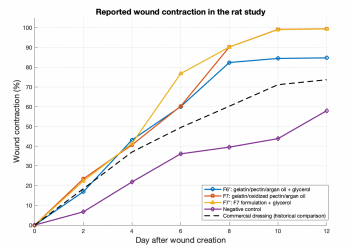
Argan oil research has now extended past food. In late 2025, experimental films from gelatin and pectin, including argan oil, were created for wound care purposes. In laboratory studies and experiments on rat wound healing models, some of the formulas demonstrated antioxidant properties, clotting function, and wound healing abilities.
This research was based on the use of argan oil as part of the film formula but not as an edible oil and was performed on animals but not people. This means that there is no direct evidence of the ability to cure wounds by using argan oil.
However, it is worth mentioning that this research is also a reflection of scientific interest in the same characteristics of culinary argan oil.
The Value of our Culinary Argan Oil
Our culinary argan oil is made to include raw materials with an easily traceable source and process. Recent scientific studies have provided us with insights into why proper sourcing, roasting, mechanical extraction, and storage play such a significant role in the formulation of our oil.
Figures for Important Studies
Study Name: Rabbaa, Soufiane, et al. “Protective Antioxidant Potential of Argan Oil versus Other Edible Oils in LPS-Challenged Mouse Heart and Kidney.” [Figure 1]
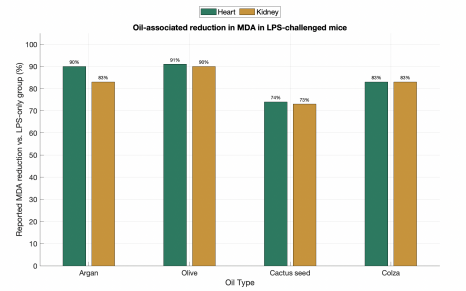
Effects of four different oil types (argan, olive, cactus-seed, and colza) on MDA levels (a biomarker of oxidative stress and lipid breakdown) in the hearts and kidneys of LPS-challenged mice (Figures 2–5).
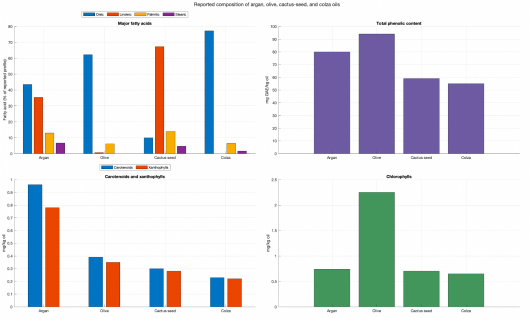
Comparative analysis of fatty acid, carotenoid, xanthophyll, phenol, and chlorophyll composition across four oil types (argan, olive, cactus-seed, and colza).
Study Name: Aridj, Taleb, et al. “Exploring the Impact of Extraction Methods on the Nutritional and Sensory Profiles of Argan Oil from Mostaganem Kernels.” [Figure 6]
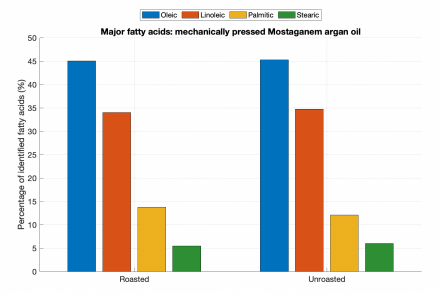
Mechanical extraction method on roasted vs unroasted argan kernels [Figure 7]
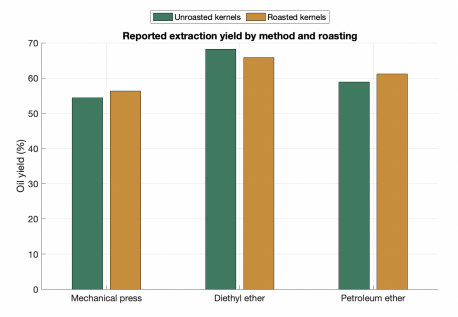
Mechanical vs conventional extraction methods on unroasted vs roasted argan kernels
Article Name: Rabbaa, Soufiane, Habiba Bouchab, Yassir Laaziouez, et al. “Argan Oil: A Natural Bioactive Lipid Modulating Oxidative Stress and Inflammation.” [Figure 8]
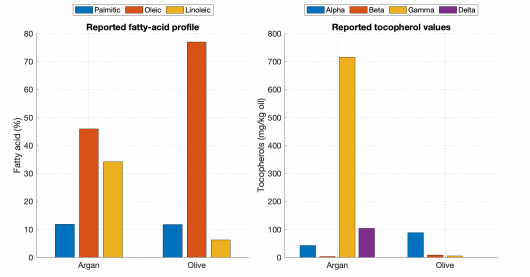
Argan vs Olive Oil in fatty-acid and tocopherol content
Article Name: Chetouani, Asma, et al. “Stable Macromolecular Emulsion with Argan Oil for Synergistic Wound Healing: From Experimental Evaluation to Healthcare Professionals’ Perception – Polymer Bulletin.” [Figure 9]
Work Cited
- Aridj, Taleb, et al. “Exploring the Impact of Extraction Methods on the Nutritional and Sensory Profiles of Argan Oil from Mostaganem Kernels.” Foods (Basel, Switzerland), U.S. National Library of Medicine, 3 Aug. 2026, pmc.ncbi.nlm.nih.gov/articles/PMC13464374/.
- Chetouani, Asma, et al. “Stable Macromolecular Emulsion with Argan Oil for Synergistic Wound Healing: From Experimental Evaluation to Healthcare Professionals’ Perception – Polymer Bulletin.” SpringerLink, Springer Berlin Heidelberg, 23 Dec. 2025, link.springer.com/article/10.1007/s00289-025-06256-7.
- Dash, Biswabhusan, et al. “Cold Pressed Oils: A Systematic Review on Physicochemical Properties, Nutritional Composition and Pharmacological Activities.” Frontiers, Frontiers, 30 June 2026, www.frontiersin.org/journals/nutrition/articles/10.3389/fnut.2026.1747029/full.
- Rabbaa, Soufiane, et al. “Protective Antioxidant Potential of Argan Oil versus Other Edible Oils in LPS-Challenged Mouse Heart and Kidney.” International Journal of Molecular Sciences, U.S. National Library of Medicine, 27 Aug. 2025, pmc.ncbi.nlm.nih.gov/articles/PMC12428758/.
- Rabbaa, Soufiane, Habiba Bouchab, Yassir Laaziouez, et al. “Argan Oil: A Natural Bioactive Lipid Modulating Oxidative Stress and Inflammation.” Antioxidants (Basel, Switzerland), U.S. National Library of Medicine, 25 Apr. 2025, pmc.ncbi.nlm.nih.gov/articles/PMC12108203/.